
Books
Fields of Physics by Finite Element Analyis - An Introduction
by Gunnar Backstrom, Updated to Version 5 (6/20/05)
Explains how to solve various partial differential equations occurring in electro- and magnetostatics, in heat transport, and in electronic conduction. It includes introductory chapters on how to generate graphics, on vector analysis, and how to solve elementary PDEs.
(Zip file containing PDF document and sample scripts for use with the free Lite Version).
This book is available free for download from our website.
Script modifications will need to be made to run with current version.
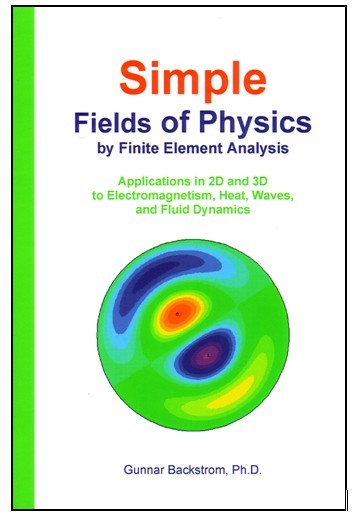
Simple Fields of Physics by Finite Element Analysis
by Gunnar Backstrom, (2012 Paperback, 322 pages)
The laws of physics may often be transformed mathematically into second-order partial differential equations (PDEs). Few of these equations have exact solutions, however, which explains why they do not receive the attention they deserve in the academic curriculum.
The main purpose of this book is to exploit the free Lite Version of FlexPDE for solving PDEs occurring in physics. It solves a typical example in seconds and promptly presents the results graphically by a variety of plots.
This book begins by presenting the graphical facilities available and solving some simple Laplace and Poisson equations. The main part of the volume is devoted to applications (in 2D and 3D) to electriciy and magnetism, heat transport, electromagnetic waves, wave mechanics and viscous flow.
The volume comprises 125 examples, illustrated by plots, and there are also end-of-chapter exercises.
Script modifications will need to be made to run with current version.
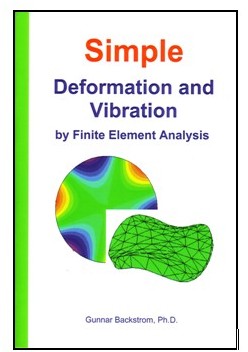
Simple Deformation and Vibration by Finite Element Analysis
by Gunnar Backstrom, (2006 Paperback, 240 pages)
The book begins by explaining the plotting facilities of FlexPDE by simple examples. After an introduction to Laplace and Poisson equations it shows how the definitions of strain, Hooke's law, and the relations of force balance lead to 2nd-order partial differential equations, which may be solved conveniently by the Free Lite Version of FlexPDE.
The first elasticity applications are elementary, but the following chapters involve an analysis of principal axes and the corresponding strains and stresses. The static analysis includes torsion, warping, and thermoelastic deformation. Forces, bending moments and energy are also obtained.
The dynamic analysis follows the same general pattern as the static counterpart, with the difference that the equations of equilibrium are replaced by Newton's law of motion. There are also chapters on resonant vibration, eigenvalues and eigenstates in both 2D and 3D.
The volume comprises 95 examples, illustrated by plots, and there are also end-of-chapter exercises.
Script modifications will need to be made to run with current version.
Multiphysics in Porous Materials
by Zhen Liu
This book summarizes, defines, and contextualizes multiphysics with an emphasis on porous materials. It covers various essential aspects of multiphysics, from history, definition, and scope to mathematical theories, physical mechanisms, and numerical implementations. The emphasis on porous materials maximizes readers understanding as these substances are abundant in nature and a common breeding ground of multiphysical phenomena, especially complicated multiphysics. Dr. Liu's lucid and easy-to-follow presentation serve as a blueprint on the use of multiphysics as a leading edge technique for computer modeling. The contents are organized to facilitate the transition from familiar, monolithic physics such as heat transfer and pore water movement to state-of-the-art applications involving multiphysics, including poroelasticity, thermohydro-mechanical processes, electrokinetics, electromagnetics, fluid dynamics, fluid structure interaction, and electromagnetomechanics. This volume serves as both a general reference and specific treatise for various scientific and engineering disciplines involving multiphysics simulation and porous materials.
- Presents the essential components of multiphysics along with innovative numerical modeling techniques in the context of porous materials
- Structured for a wide range of readers from those new to the field to experts, instructors, researchers, software developers, and modelers from many scientific and engineering disciplines
- Organized using a practical approach that combines a logical presentation of theories with illustrative hands-on example problems
- Reinforces multiphysics concepts with applications demonstrating the use of common software to solve representative problems
This book is available for purchase in electronic form at Springer.
This material is also discussed on Dr. Liu's website at www.multiphysics.us.

A Course In Computational Electrostatic Field Theory
by Dr. Frederick J. Young
Electrostatic problem solving in two and three dimensions is explained using FlexPDE. It is written for advanced students who have had courses in basic electrostatics.
The goal of this book is to enable students to use finite elements to solve many of the problems of electromagnetic field theory that cannot be solved analytically by advanced mathematical analysis.
Being able to quickly get solutions to new problems, make changes in them and view the results graphically leads more rapidly to physical understanding than spending hours working with complex mathematics.
This book is available for purchase in electronic form at GooglePlay and other online sources.
Methods of Mathematical Physics in Signal and Image Processing
by Eugene B. Postnikov written in Russian
FlexPDE usage for the modeling of image processing (Edge Detection, Diffusion Smoothing, and Wavelet Transform) via methods of Mathematical Physics. All topics are supplied with the examples and exercises for FlexPDE free Lite Version.
Script modifications will need to be made to run with current version.
This e-book (in Russian) is available for purchase at GRIN Verlag.
(The GRIN Verlag site is in German, but English and French are available in the upper right corner of the site.)
Reprints
Dune soil nitrogen leaching for Chinese-yam cultivation: Impact of microbe-decomposable slow-release fertilizer
A. Endo Heliyon, 10(9) , e30545, 2024
Respiration Measurements of Individual Tardigrades of the Species Richtersius cf coronifer as a Function of Temperature and Salinity and Termination of Anhydrobiosis
Bjarke H. Pedersen, Hans Malte, Kai Finster, and Hans Ramløv
Astrobiology - 29 Apr 2021
Landfill Gas Flow: Collection by Horizontal Wells
Yana Nec, Greg Huculak
G. Transp Porous Med (2019)
Development of Thermal Conductivity Apparatus for Ablative Composite Materials
Ramin Shilav, Amiram Leitner, Alon Gany
57th Israel Annual Conference on Aerospace Sciences, March 15-16, 2017
Download PDF (472K)
Horizontal landfill gas wells: Geometry, physics of flow and connection with the atmosphere
Damian Halvorsen, Yana Nec, Greg Huculak
Physics and Chemistry of the Earth, Parts A/B/C - manuscript accepted
Effects of Deep Underdrainage in the Large Scale Chinese Yam Upland Field during Growing Period in Byobusan-area, Aomori Prefecture
Akira ENDO, Koh KATO, Bikash C. SARKER
Geoderma, 319 (2018), 24-33
Leaching characteristics of nitrate nitrogen in an apple orchard andosol under significant snow accumulation
Akira ENDO, Yusuke ABUKAWA, Michio KAWASAKI, Chihiro KATO, Choichi SASAKI
Transactions of The Japanese Society of Irrigation, Drainage and Rural Engineering, 86(1) (2018), I_129-I_137
Consideration of Snow Cover and Snowmelt upon the Inorganic Nitrogen Leaching Characteristics of an Apple Orchard in a Gray Lowland Soil
Akira ENDO, Daiyu ITO, Koh KATO, Chihiro KATO, Choichi SASAKI
Transactions of The Japanese Society of Irrigation, Drainage and Rural Engineering, 85(2) (2017), I_221-I_231
Net Fluorescein Flux Across Corneal Endothelium Strongly Suggests Fluid Transport is due to Electro-osmosis
J. M. Sanchez, V. Cacace, C. F. Kusnier, R. Nelson, A. A. Rubashkin, P. Iserovich, J. Fischbarg
J Membrane Biol (2016) 249:469-473
Download PDF (503K)
Groundwater flow as a cooling agent of the continental lithosphere
Henk Kooi
Nature Geoscience (2016) online
DOI: 10.1038/ngeo2642
Simple pde model of spot replication in any dimension
Chiun-Chuan Chen and T. Kolokolnikov
SIAM Journal of Mathematical Analysis
44(5), pp.3564-3593 (2012)
Download PDF (616K)
Recovering multiple small inclusions inside an a three dimensional domain using a single measurement
T. Kolokolnikov and Alan Lindsay
Inverse Problems in Science & Engineering to appear
Download PDF (688K)
Mean first passage time for a small rotating trap inside a reflective disk
J. Tzou and T. Kolokolnikov
SIAM Multiscale Modeling and Simulation
Vol. 13, No. 1, pp. 231-255 (2015)
Download PDF (1.43M)
Nitrate percolation and discharge in cropped Andosols and Gray lowland soils of Japan
Akira Endo, Shin-Ichiro Mishima, Kazunori Kohyama
Nutrient Cycling in Agroecosystems
January 2013, Volume 95, Issue 1 , pp 1-21
DOI: 10.1007/s10705-012-9544-7
Modeling of Active and Passive Nonlinear Metamaterials
P. L. Colestock, M. T. Reiten and J. F. O'Hara
August 21, 2012
Download PDF (1.3M)
Strength Prediction for Glass Lites of Any Shape Exposed to Uniform or Non-uniform Lateral Loads.
W. Alan Dalgliesh and James B. Posey
2010 International Conference on Building Envelope Systems and Technologies (ICBEST 2010)
Download PDF (705K)
Self-sustained biochemical oscillations and waves with a feedback determined only by boundary conditions.
E. B. Postnikov*, A. Yu. Verisokin, D. V. Verveyko, and A.I. Lavrova
Phys. Rev. E 81, 052901 (2010)
Collisions between two nonlinear deformable bodies stated within Continuum Mechanics.
Fernando S. Buezas, Marta B. Rosales and Carlos P. Filipich
International Journal of Mechanical Sciences
Volume 52, Issue 6, June 2010, Pages 777-783
FEM Simulation of the temperature distribution and power density at platinum cathode craters caused by high voltage ignition discharges.
N Jeanvoine and F Muecklich
J. Phys. D: Appl. Phys. 42 (2009) 035203 (9pp)
January 14, 2009
Modeling nitrate leaching on a cropped Andosol.
A. Endo, S. Mishima and K. Kohyama
Nutrient Cycling in Agroecosystems
September 2009, Volume 85, Issue 1, pp 41-61
DOI: 10.1007/s10705-009-9247-x
Use of a General Partial Differential Equation Solver for Solutions of Mass and Heat Transfer Problems in Geotechnical Engineering.
Pentland, Gitirana and Fredlund
4th Brazilian Symposium on Unsaturated Soils, March 2001, 29-45pp.
Download PDF (306K)
Two-dimensional simulation of filaments in barrier discharges.
Steinle, Neundorf, Hiller and Pietralla
J. Phys. D: Appl. Phys. 32(1999) 1350-1356
Download PDF (201K)
Calculation of inductive electric fields in pulsed coaxial devices using electric vector potentials.
G. F. Kiuttu
Download PDF (278K)
What's my impedance?
Daniel G. Swanson, Jr.
Download PDF (752K)
Simple Finite Element modelling applied to the problems in Energetic Materials Characterisation: Design of Pyrotechnic Devices and Explosives Calorimetric Studies.
M Braithwaite, N Davies, W C Evans & P D Lightfoot
Download PDF (237K)
Magnetostatic analysis of a brushless DC motor using a two-dimensional partial differential equation solver.
Kostaridis, Soras and Makios
Computer Applications in Engineering Education Journal
Volume 9, Issue 2, 2001, pp. 93-100
Download PDF (362K)
Thermal Bridges - Heatflow Models with Heat2, Heat3 and a General Purpose 3D Solver.
James B. Posey and W.A. Dalgliesh
10th Canadian Conference on Building Science and Technology,
Ottawa, May 2005
Download PDF (2630K)
Acoustooptic Resonance in Deep-Etched GaAs-AlGaAs Electrooptic Modulators.
Watson, Poirier, Heaton, Lewis, and Boudreau
Journal of Lightwave Technology, Vol. 22, No. 6, June 2004, pp1598-1603
Download PDF (4290K)
Adaptive Forward-Inverse Modeling of Resevoir Fluids Away from Wellbores.
Doss, Gelinas, Nelson, and Ziagos
LLNL Report UCRL-ID-126377
Feb 1999
Download PDF (27M)