|
|||||
|
|
|
|
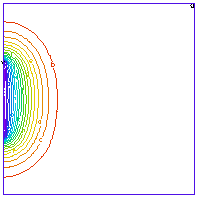
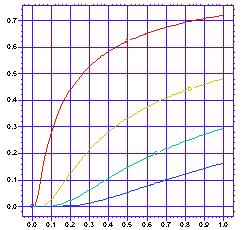
{ ************** COMMENT **************** DIFFUSION.PDE This problem considers the thermally driven diffusion of a dopant into a solid from a constant source. Parameters have been chosen to be those typically encountered in semiconductor diffusion.
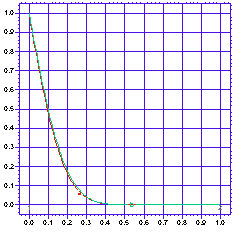
The natural tendency in this type of problem is to start off with zero concentration in the material, and a fixed value on the boundary. This implies an infinite curvature at the boundary, and an infinite transport velocity of the diffusing particles. It also generates over-shoot in the solution, because the Finite-Element Method tries to fit a step function with quadratics. A better formulation is to program a large input flux, representative of the rate at which dopant can actually cross the boundary, (or approximately the molecular velocity times the concentration deficiency at the boundary). Here we use a masked source, in order to generate a 2-dimensional pattern. This causes the result to lag a bit behind the analytical Plane-diffusion result at late times. *************** END COMMENT **************}
|